Breach Autopsy: PayPal's "Application Error" That Took Six Months to Detect
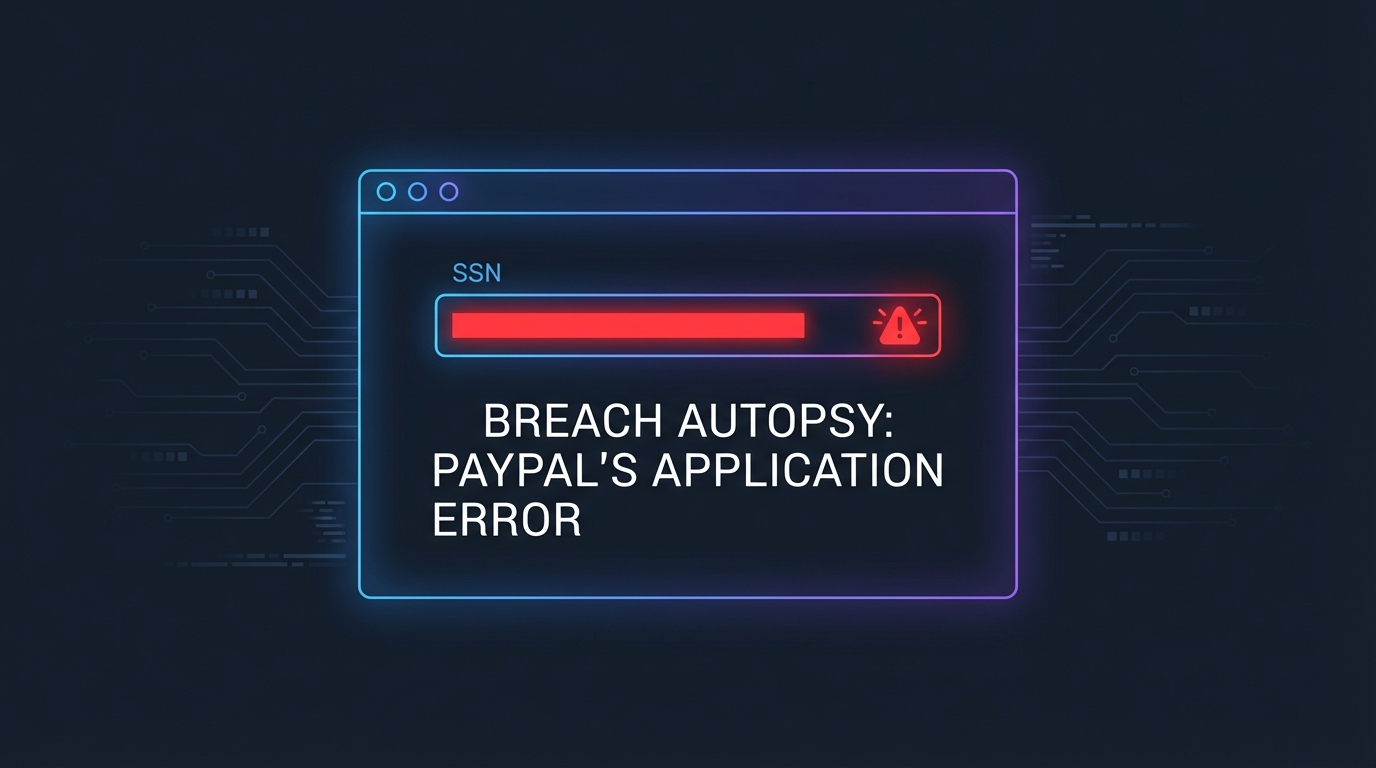
PayPal disclosed that a coding error exposed loan application data, including Social Security numbers, for six months before detection.
Incident: PayPal Working Capital (PPWC) loan application data exposure
Duration: Six months of undetected exposure
Disclosed: February 10, 2026 (breach notification letters sent)
Data exposed: Social Security numbers (SSNs), personal information
Impact: "A few" fraudulent transactions occurred before detection
Lesson: "Application error" is compliance language for "we didn't notice"
PayPal just disclosed that customer data - including Social Security numbers - was exposed for nearly half a year due to a coding error in its PayPal Working Capital loan application. Breach notification letters were sent to affected customers on February 10, 2026. The exposure led to what PayPal describes as "a few" unauthorized transactions. Detection took six months.
Let's decode what that actually means. And why this should terrify anyone running a fintech platform.
What We Know
In breach disclosure language:
- "Sophisticated attack" = We got phished
- "Advanced persistent threat" = We didn't detect them for months
- "Zero-day vulnerability" = Vendor's fault, not ours
- "Application error" = We broke our own security controls
Translation for PayPal's disclosure: This wasn't a cyberattack. This was a bug. Probably in access control logic, data filtering, or API response handling. The application was returning data it shouldn't have been returning. And nobody noticed for six months.
Why companies use this language: "Application error" sounds less bad than "we shipped a security vulnerability to production and didn't catch it." It frames the issue as a technical glitch rather than a security failure.
Why that's misleading: Application security is security. If your code leaks data, that's a vulnerability. Whether it came from malicious actors or your own developers doesn't change the impact.
The Likely Shape
Here's the timeline that should keep security teams up at night:
- Day 0: Application error introduced (likely during a code deployment or configuration change)
- Day 1-180: Customer data exposed via application responses, logs, or API endpoints
- Somewhere in that window: Fraudulent transactions occur using exposed data
- Day 180: Detection finally happens (triggered by fraud investigation? Customer complaint? Internal audit?)
- Feb 23, 2026: Public disclosure
Six months.
That's not a detection gap. That's a monitoring failure.
Technical Autopsy
Confirmed details (from official breach notification):
The vulnerability was in PayPal Working Capital (PPWC), PayPal's small business loan application platform. According to breach notification letters filed with the Massachusetts Attorney General on February 10, 2026:
- Cause: Software coding error (not a cyberattack)
- Data exposed: Social Security numbers (SSNs), personal information of loan applicants
- Duration: Approximately 6 months of continuous exposure
- Fraud impact: PayPal confirmed unauthorized transactions occurred (described as "a few" in public disclosures)
- Detection: The error was discovered during an internal security review
As The Register reported: "A software coding error - not a hacker - is behind PayPal's latest data breach disclosure."
The technical failure pattern:
Scenario 1: Over-Privileged API Responses
Application returns more data than intended. User requests their own account info, API response includes other users' data in the payload. Or admin-level data accidentally exposed to regular users.
How fraud occurs: Attacker (or opportunistic user) notices the extra data, collects credentials, payment methods, or session tokens, uses them for unauthorized transactions.
Scenario 2: Logging Exposure
Application logs sensitive data (payment card details, security answers, authentication tokens) to log files accessible to unauthorized parties. Common in debugging environments pushed to production.
How fraud occurs: Logs scraped for credentials, used to access accounts or make fraudulent payments.
Scenario 3: Access Control Logic Bug
Application fails to enforce user isolation. UserA can request /api/transactions?user=UserB and the application returns UserB's transaction history.
How fraud occurs: Enumeration attack - iterate through user IDs, collect payment methods or account details, use them for fraud.
Scenario 4: Data Leak via Error Messages
Application error responses include sensitive information (stack traces with database schemas, error messages with user data). Common when debug mode is left on in production.
How fraud occurs: Attackers trigger errors to harvest data, use it for account takeover or payment fraud.
The common thread: These aren't sophisticated attacks. They're basic application security mistakes that went undetected.
PayPal's PPWC case likely fits Scenario 1 or 3: A loan application system that returned more applicant data than authorized, exposing SSNs and personal information across users. The 6-month duration suggests the bug was in core application logic, not a one-off edge case - it happened consistently for everyone using the PPWC loan portal.
Why Detection Took Six Months
Six months is not an outlier. It's embarrassingly common.
Average time to detect data breach (Verizon DBIR): 21 days for internal discovery, much longer for external notification.
Why detection is so slow:
1. Lack of data access monitoring
Most organizations monitor for intrusions (unauthorized logins, malware, network scanning). Few monitor for data leakage from legitimate application functions.
Question PayPal should have been asking: "Is this API endpoint returning more data than this user should see?"
Reality: That's a hard question to monitor for. It requires understanding application logic, user entitlements, and normal vs. abnormal data access patterns.
2. Logs nobody reads
Application logs exist. Security logs exist. But unless something breaks, nobody's reading them daily.
PayPal probably had logs showing:
- API responses with unusual data volumes
- Users accessing data for accounts they shouldn't have access to
- Fraudulent transaction patterns tied to compromised credentials
But logs without monitoring are just data exhaust.
3. Fraud detection != security monitoring
PayPal has sophisticated fraud detection (they catch billions in fraud annually). But fraud detection focuses on transaction patterns (is this purchase legitimate?), not data access patterns (should this user see this data?).
The gap: Fraud systems detected the fraudulent transactions eventually. But by then, the data had already been exposed for months. Security monitoring should have caught the data exposure before fraud occurred.
4. No automated access control validation
Question: If your application is supposed to restrict UserA from seeing UserB's data, how do you verify that's actually working in production?
Common answer: "We tested it before deployment."
Better answer: "We test it continuously in production with automated access control probes."
PayPal apparently didn't have the better answer.
What This Means for PCI DSS Compliance
PayPal is a PCI DSS Level 1 merchant (the highest tier - processes >6M transactions annually). They're audited annually by a Qualified Security Assessor (QSA).
PCI DSS requirements this incident likely violated:
Requirement 6: Develop and maintain secure systems and applications
- 6.3.2: Review custom code prior to release to production
- 6.4.6: Address vulnerabilities and patch as required
Requirement 10: Log and monitor all access to network resources and cardholder data
- 10.2.2: Implement automated audit trails for all system components to reconstruct events
- 10.6: Review logs and security events for all system components
Requirement 11: Test security of systems and networks regularly
- 11.3.1: Perform external penetration testing at least annually
- 11.3.2: Perform internal penetration testing at least annually
The compliance question: How did PayPal pass PCI DSS audits with a six-month detection gap?
Possible answers:
- The vulnerability was introduced after the most recent audit. (PCI audits are annual. If the bug shipped post-audit, it wouldn't be caught until next year.)
- Testing didn't cover this scenario. (Penetration tests might not have included API response validation or access control enumeration.)
- Monitoring was technically compliant but ineffective. (Logs existed, automated monitoring existed, but nobody configured alerts for data over-exposure.)
The uncomfortable truth: PCI DSS compliance does not prevent breaches. It sets a baseline. And that baseline assumes you're actually using your monitoring systems effectively, not just checking a box.
Lessons for Financial Services (And Everyone Else)
1. Monitor for data leakage, not just intrusions
Traditional monitoring: Unauthorized login attempts, malware, network scans
Needed: Data access anomalies - users seeing data they shouldn't, API responses containing excessive information, unusual data export volumes
How: Implement data loss prevention (DLP) for APIs, not just email and file transfers. Monitor API response payloads for sensitive data patterns (PII, payment card numbers, tokens).
2. Test access controls in production (not just pre-deployment)
Bad approach: "We tested access controls in staging before release."
Better approach: Continuous automated validation - probes that periodically test if access controls are working as designed.
Example: Automated script that attempts to access UserB's data while authenticated as UserA. If it succeeds, alert fires.
3. Fraud detection is not a substitute for security monitoring
Fraud systems answer: "Is this transaction legitimate?"
Security monitoring answers: "Should this user have access to this data?"
Both are necessary. Neither is sufficient alone.
PayPal's failure: Fraud detection caught fraudulent transactions. Security monitoring should have caught the data exposure before fraud occurred.
4. "Application error" disclosures require root cause analysis
When you see "application error" in a breach disclosure, ask:
- What code change introduced the error?
- Was the code reviewed for security implications?
- Why didn't pre-production testing catch it?
- Why didn't production monitoring catch it?
- How are you preventing similar errors in the future?
For PayPal: We'll see if they publish a more detailed root cause analysis. If they don't, customers should demand it.
5. Detection speed matters more than perfection
You will ship bugs. You will introduce vulnerabilities. That's unavoidable in complex systems.
What's not unavoidable: Taking six months to detect them.
Goal: Reduce detection time from months to days (or hours).
How:
- Automated access control validation
- DLP for API responses
- Anomaly detection for data access patterns
- Security chaos engineering (intentionally test if access controls break)
What Regulators Will Want to Know
This incident will draw regulatory scrutiny. Expect inquiries from:
- OCC (Office of the Comptroller of the Currency) - oversees PayPal's banking partnerships
- CFPB (Consumer Financial Protection Bureau) - consumer protection for financial services
- State AGs - breach notification laws vary by state, class action lawsuits likely
- EU regulators (if EU customers affected) - GDPR notification required within 72 hours of discovery (not occurrence)
Key questions regulators will ask:
- When did the error occur vs. when was it detected? (Six-month gap is the problem)
- What monitoring systems were in place? Why didn't they detect this?
- What customer data was exposed? What fraud occurred?
- What remediation steps are being taken? (Code fix? Monitoring improvements? Customer notifications?)
- How are you ensuring this doesn't happen again?
Compliance headache: If the vulnerability was detectable via standard penetration testing or log monitoring, regulators may argue PayPal's security program was deficient.
What Customers Should Do
If you're a PayPal user:
- Watch for breach notification. PayPal is required to notify affected users (state breach notification laws + card brand rules).
- Monitor for fraud. Check transaction history, enable fraud alerts, consider freezing your account temporarily if you suspect exposure.
- Change credentials. If your PayPal account was accessed during the exposure window, change your password. Enable two-factor authentication (2FA) if you haven't already.
- Consider alternatives. If you're a business relying on PayPal for payment processing, this is a reminder to have backup payment processors (Stripe, Square, etc.).
If you're a developer/security team:
This is your reminder to check: Are you monitoring for data leakage from your own application logic, or just external attacks?
The Hard Truth
Six months is a governance failure, not just a technical failure.
Technical failure: Bug introduced, data exposed
Governance failure: No monitoring detected it, no testing caught it, no review process flagged it
PayPal has:
- Thousands of engineers
- Dedicated security teams
- PCI DSS Level 1 compliance
- Billions in revenue
- Decades of experience in financial services
And they still took six months to detect an application error leaking customer data.
If PayPal struggles with this, every fintech startup should be asking: What are we missing?
The 7-Day Containment and Comms Checklist
Immediate (This Week):
- [ ] Review application logs for unusual data access patterns (last 30 days minimum)
- [ ] Audit API endpoints: Are responses filtered correctly per user role?
- [ ] Check production logging configuration: Are you logging sensitive data?
30 Days:
- [ ] Implement automated access control validation (periodic tests in production)
- [ ] Deploy data loss prevention (DLP) monitoring for API responses
- [ ] Red team exercise: Can attackers access other users' data via API enumeration?
90 Days:
- [ ] Establish data access anomaly detection (unusual volumes, cross-user access patterns)
- [ ] Separate fraud detection from security monitoring (both needed)
- [ ] Document detection SLAs: How fast should we catch data exposure? (Hours, not months)
Ongoing:
- [ ] Include access control testing in every penetration test
- [ ] Require security code review for any change touching user data isolation
- [ ] Monthly: Review detection time for past incidents (Are we getting faster?)
Related:
- BeyondTrust ransomware - different vector (RCE), same lesson (detection gaps kill you)
- PCI DSS compliance - compliance ≠ security
- Application security monitoring - monitoring for data leakage, not just intrusions
- Zero Day Docket - cybersecurity for professionals who need to understand real risks
Updates: (Will update as PayPal provides more technical details or regulatory actions emerge)